5 Signs It's Time to Fire Your Ad Agency
February 12, 2026

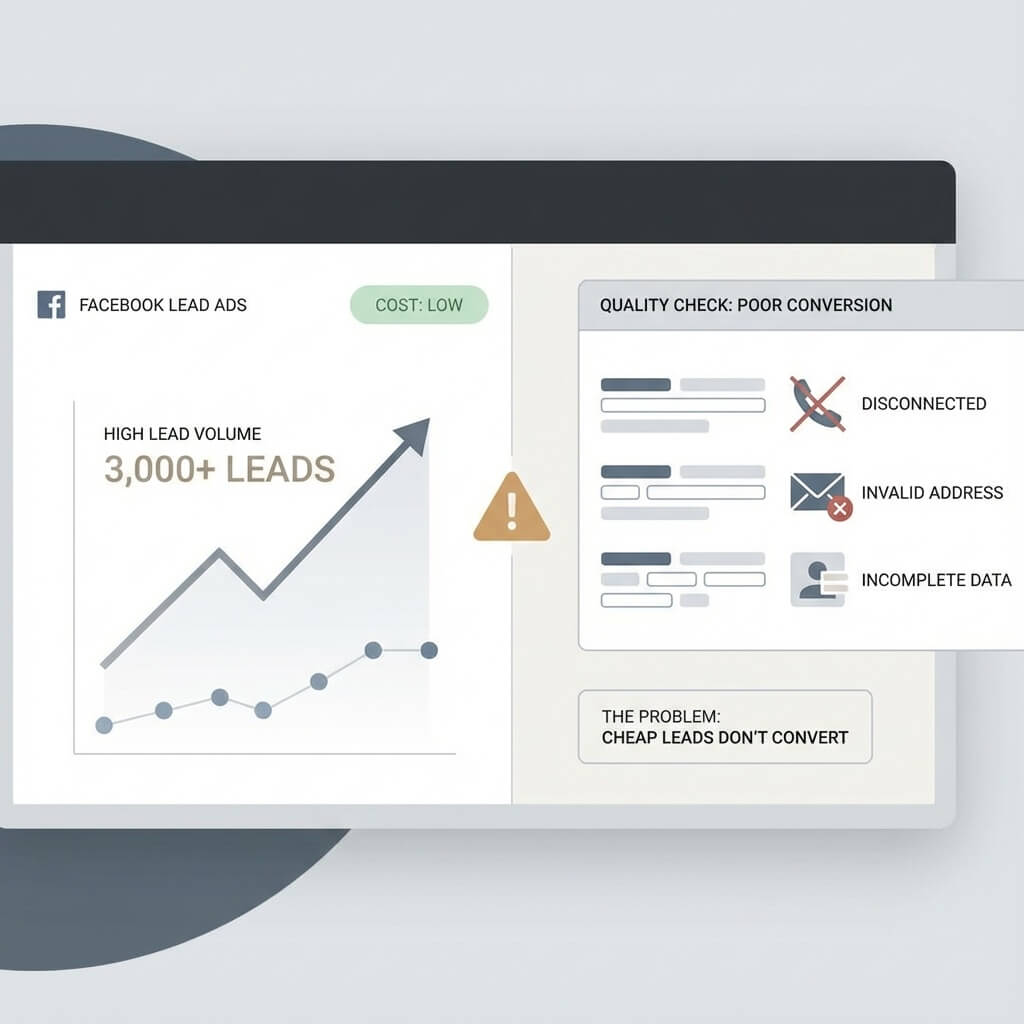
Your cost per lead looks great. Five dollars, maybe ten. Your ads are working, at least according to the numbers.
But then you call these leads. Half the phone numbers are wrong. The ones who do answer have no idea why you are calling. And the handful who remember submitting a form? They cannot afford what you sell or were never serious in the first place.
This is one of the most common frustrations we hear from business owners running Facebook lead ads. The leads are cheap, but they never turn into customers. The math looks good on paper until you realize that a $5 lead who never buys is infinitely more expensive than a $25 lead who does.
Let’s talk about why this happens and how to fix it. We will keep this practical and jargon-free because you do not need to be a media buyer to understand this problem or solve it.
To understand why your leads are low quality, you need to understand how Facebook thinks about your ads.
Think of Facebook's advertising system like a very eager assistant. You tell it what you want, and it goes out and finds people who will give you exactly that.
When you tell Facebook "I want leads," it hears "Find me people who will fill out a form." So it goes and finds people who are most likely to fill out forms. Not people who are most likely to buy your product. Not people who are actually qualified prospects. Just people who fill out forms.
It turns out there is a whole category of Facebook users who will fill out almost any form they see. They are bored, curious, or just compulsive clickers. Facebook knows who these people are, and it will happily deliver them to you in bulk because that is technically what you asked for.
Facebook's "instant forms" make this problem worse. These are the lead forms that pop up within Facebook, pre-filled with the user's information. Submitting takes one tap. No typing required.
Low friction sounds like a good thing. And it is, if your goal is simply collecting contact information. But low friction also means low commitment. People submit these forms without thinking. Sometimes they do it by accident. They certainly do not feel invested in whatever they signed up for.
When you call these people two hours later, many genuinely do not remember submitting the form. They were scrolling, tapped something, and moved on. That is not a lead. That is a name on a list.
Understanding the root causes helps you fix them. Here are the five most common reasons we see for poor lead quality.
This is the most fundamental issue. When you set up a lead generation campaign, Facebook asks what you want to optimize for. Most people choose "Leads" because that seems obvious.
But remember what we said about Facebook being a very literal assistant. When you optimize for leads, Facebook finds people who submit forms. It does not care what happens after the form submission.
The fix is to optimize for a later step in your process. If your goal is booked calls, optimize for booked calls. If you run webinars, optimize for webinar attendance or even purchases. This tells Facebook to find a completely different type of person, one who not only submits a form but actually takes the next step.
Generic messaging attracts generic people. If your ad says something like "Want to learn more? Sign up now!" you will get everyone who is mildly curious about anything.
Your ad itself is a filter. The words you use, the images you show, the tone you take. All of these either attract your ideal customer or repel them.
Think about who you actually want. What do they care about? What language do they use? What would make them think "this is for me" versus "this is for everyone"? The more specific your ad, the more it will resonate with the right people and be ignored by the wrong ones.
This sounds backward, but hear me out. Some friction is good.
When someone has to put in a little effort to submit a form, they are more invested. They actually want what you are offering. They are not just impulsively clicking.
Adding qualifying questions to your form creates healthy friction. Ask about their budget. Ask about their timeline. Ask about their company size or role. These questions serve two purposes: they give you information to qualify the lead, and they filter out people who are not serious enough to answer them.
Yes, your cost per lead will go up. But your cost per qualified lead will go down. And that is the number that actually matters.
Lead quality degrades fast. The moment someone submits a form, they are at peak interest. An hour later, they have moved on with their day. Two days later, they have forgotten you exist.
If your sales team is calling leads 48 hours after submission, you are not calling warm leads. You are cold calling people who vaguely remember giving someone their phone number.
The data on speed to lead is overwhelming. Contact a lead within 5 minutes and you are dramatically more likely to reach them and convert them than if you wait even 30 minutes. Every hour of delay reduces your chances significantly.
Facebook used to let advertisers target by income level, job title, and other useful filters. Most of those options are gone. You cannot tell Facebook "only show this to people making $100,000 or more."
This means your ad and offer have to do the filtering that targeting used to do. If you sell a premium service, your ad needs to communicate that. Price anchoring, outcome framing, and qualification language all help attract people who can actually afford what you sell.
Running broad targeting with a premium offer is a recipe for unqualified leads. You will get plenty of interest from people who want the outcome but cannot pay for it.
Now let’s talk solutions. These fixes range from quick adjustments to more fundamental changes in how you run campaigns.
This is the highest-impact change you can make. Instead of telling Facebook to find people who submit forms, tell it to find people who take meaningful action.
If you sell through calls, set up tracking for booked calls and optimize for that. If you run webinars, optimize for webinar attendance or even for purchases made after the webinar. If you sell directly, optimize for purchases.
This requires proper tracking setup, which is technical but not complicated. Once it is in place, Facebook will start finding an entirely different type of person because you have defined success differently.
The questions you ask in your form communicate expectations and filter out tire-kickers. Consider adding questions like:
What is your approximate budget for this project?
When are you looking to get started?
What is your role in making this decision?
These questions accomplish two things. First, they give you information to prioritize which leads to call first. Second, they create friction that filters out people who are not serious. Someone who will not spend 30 seconds answering basic questions is not going to spend thousands on your service.
Your ad creative does targeting work that Facebook's audience settings cannot do anymore. Be intentional about who you show and what you say.
If your ideal customer is a successful business owner, show successful business owners in your ads. If you serve a specific age group, show that age group. Use language and references that resonate with your target and alienate everyone else.
It is okay to repel the wrong people. In fact, it’s the goal. An ad that appeals to everyone appeals to no one strongly. An ad that speaks directly to your ideal customer will be ignored by everyone else, and that is exactly what you want.
Instant forms are convenient, but they trade conversion rate for lead quality. A landing page creates more friction, which means fewer leads but better leads.
When someone clicks to your website, reads about your offer, scrolls through the page, and then fills out a form, they are much more invested than someone who tapped a pre-filled form without leaving Facebook.
Test both approaches and compare quality, not just quantity. You might find that landing pages deliver half the leads at twice the cost but four times the conversion rate. That is a win even though it looks worse in your ads dashboard.
If you cannot call leads within 5 minutes, automate your initial response. Send an immediate email or text confirming their submission. Include next steps. Set expectations for when you will call.
Better yet, use scheduling tools so leads can book their own calls immediately after submitting the form. This captures their intent while it is still hot and locks in a time before they forget about you.
For high-value leads, make the investment in immediate follow-up. Some businesses have sales reps dedicated to calling leads within minutes of submission. The conversion rate difference justifies the cost.
Let'd reframe how you think about lead cost. A low cost per lead is not inherently good. It is only good if those leads turn into customers.
Here is a simple example. Say you spend $1,000 on ads.
Scenario A: You get 200 leads at $5 each. Two of them buy, giving you a cost per customer of $500.
Scenario B: You get 50 leads at $20 each. Five of them buy, giving you a cost per customer of $200.
Scenario B looks worse in your ads dashboard. Higher cost per lead, fewer leads. But it is dramatically more profitable because the leads actually convert.
The metric that matters is not cost per lead. It is cost per qualified lead or cost per customer. Everything else is a vanity metric that can actually mislead you into celebrating bad performance.
Cheap leads are not actually cheap if they never convert. Every hour your sales team spends calling unqualified leads is an hour they could spend closing qualified ones.
The fixes we’ve discussed are not complicated. Optimize for a later conversion event. Add qualifying questions. Use your creative as a filter. Consider landing pages. Speed up follow-up. Any one of these changes can meaningfully improve your lead quality.
The hard part is accepting that better leads might mean fewer leads and higher costs in your ads dashboard. That is a mental hurdle, especially when you have been trained to celebrate low cost per lead.
But when you shift your focus from lead quantity to lead quality, everything changes. Your sales team gets more productive. Your customer acquisition cost actually drops. And the leads you talk to are people who genuinely want what you sell.
If you want someone to audit your lead generation setup and identify where quality is breaking down, we are happy to help. Sometimes a fresh set of experienced eyes can spot issues that are invisible when you are in the weeds every day.
%20(1).webp)